SIMILARITIES:
- Both are insoluble in water
- Both are neutral
- Both burn in excess air to
produce carbon dioxide and water.
DIFFERENCES:
Alkanes:
- General formula: CnH2n+2
- Saturated hydrocarbon
- Do not decolourise the
purple acidified potassium manganate (VII) solution.
- Do not decolourise the
reddish-brown bromine solution.
- Burn with a less sooty flame
because the percentage by mass of carbon is lower than that of the
corresponding alkenes.
Alkenes
- General formula: CnH2n
- Unsaturated hydrocarbon
- Decolourise the purple
acidified potassium manganite (VII) solution.
- Decolourise the
reddish-brown bromine solution.
- Burn with a more sooty flame
because the percentage by mass of carbon is higher than that of the corresponding
alkanes.

- Rate of reaction: The
decrease in the amount of reactant used or the increase in the amount of
product obtained in a given time. The rate of reaction measures how much
product is formed in a certain time. Some reactions are slow, such as rusting,
and some are fast, like burning.
- Average of reaction: The
average value of the rate of reaction within a specified period of time.
- Rate of reaction at a given
time: The actual rate of reaction at a specific time.
- Collision theory: A model
that explains reaction rate as the result of particles colliding with a certain
minimum energy.
- Effective collision: A
collision in which the particles meet with sufficient energy and an orientation
that allows them to react.
- The rate of reaction
decreases with the increase of time.
- The rate of reaction
increases as the total surface area of a solid reactant increases.
- The rate of reaction
increases as the concentration of reactant increases.
- The rate of reaction
increases as the temperature of a reactant increases.
- The rate of reaction
increases when a positive catalyst is used and the rate of reaction increases
when the amount of a positive amount used increases.
- Catalyst: A substance which
alters the rate of a chemical reaction while it remains chemically unchanged at
the end of the reaction.
Similarities:
- Both are cleansing agents.
- Each ion of both soap and
detergent consists of a long chain of hydrocarbon part which is hydrophobic and
an ionic part which is hydrophilic.
- Both can reduce the surface
tension of water, thus, allowing water to wet the surface.
- The cleansing actions of
both soap and detergent enable oil droplets to disperse in water and form an
emulsion that will not redeposit on the surface.
- Both are effective as
cleansing agents in soft water.
Differences:
- Soap is biodegradable while detergent
is not biodegradable (can cause environmental pollution).
- Detergent is an effective
cleansing agent in hard water, soft water and in acidic solution but soap is only
effective as a cleansing agent in soft water.

- Salts: An ionic compound
formed when the hydrogen ion in an acid is replaced by a metal ion or an ammonium
ion. Salts are formed as the product of an acid reaction with an alkali.
Soluble salts dissolve in water. Insoluble salts do not dissolve in water.
- Recrystallization: A
technique used to purify crystals of a soluble salt by carrying out the
crystallization process again on these crystals.
- Precipitation reaction: A
reaction which involves the reaction between two aqueous reactants to form an insoluble
substance.
- Continuous variation method:
An experiment which involves the reaction of a solution at fixed volume and
another solution with volumes that varies uniformly.
- All carbonate salts are
decomposed on heating to liberate carbon dioxide gas, CO2 except
sodium carbonate, Na2CO3 and potassium carbonate, K2CO3.
- All nitrate salts are
decomposed on heating to liberate nitrogen dioxide gas, NO2 and
oxygen gas, O2 except sodium nitrate, NaNO3 and potassium
nitrate, KNO3 which liberate oxygen gas, O2 only.
- The presence of carbonate
ions can be confirmed by adding dilute acids.
- The presence of sulphate
ions can be confirmed by adding acidified barium chloride, BaCl2
solution.
- The presence of chloride
ions can be confirmed by adding acidified silver nitrate, AgNO3 solution.
- The presence of nitrate ions
can be confirmed by adding dilute sulphuric acid, H2SO4
followed by iron (II) sulphate, FeSO4 solution and a little concentrated
sulphuric acid, H2SO4.
- The identify of cation can
be determined by using sodium hydroxide, NaOH solution and ammonia, NH2
solution except aluminium ion, Al3+ and lead (II) ion, Pb2+.
- Ammonium ion can be tested
by heating with a strong alkali or adding Nessler’s reagent.
- Iron (II) ion and iron (III)
ion can be tested by using potassium hexacyanoferrate (II), K4Fe(CN)6
solution, potassium hexacyanoferrate (III), K3Fe(CN)6 or
potassium thiocyanate, KSCN solution.
- Lead (II) ions can be tested
by using potassium iodide, KI solution.
- Sulphuric acid (H2SO4)
is a highly corrosive acid made from sulfur dioxide; widely used in the
chemical industry.
- Contact process: the
industrial process for making sulfuric acid.
- Ammonia (NH3) is colorless,
pungent gas composed of nitrogen and hydrogen.

- Haber process: the process
for making ammonia from nitrogen and hydrogen, in industry.
- Ammonium fertilizer: A salt
that is prepared from the reaction between ammonia and an acid. Ammonium
sulphate, (NH4)2 SO4 which is an ammonium
fertilizer can be prepared from the reaction between ammonia, NH3
solution and sulphuric acid, H2SO4.
- Alloys: A mixture of two or
more elements with certain fixed composition in which the major component is a
metal. Alloy is harder than pure metal.
- Metal corrosion: The gradual
destruction of a metal by reaction with its environmental. Iron rusts faster
than steel. Stainless steel does not rust.
- Polymer: a compound
containing very large molecules, formed by polymerization.
- Synthetic polymers are
derived from petroleum oil, and made by scientists and engineers. Examples of
synthetic polymers include nylon, polyethylene, polyester, Teflon, and epoxy.
- Natural polymers occur in
nature and can be extracted and often water-based. Examples of naturally
occurring polymers are silk, wool, DNA, cellulose and proteins.
- Glass: A homogeneous material
with a random, liquid-like molecular structure.
- Ceramic is a hard, unreactive material
that can withstand high temperatures, made by baking clay in a kiln; ceramics
are non-conductors.
- A "composite"
material is when two or more different materials are combined together to
create a superior and unique material.
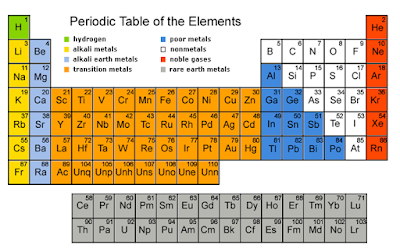
- Periodic Table: the table
showing the elements in order of increasing proton number; similar elements are
arranged in columns called groups.
- Group: A vertical column of
elements in the Periodic table.
- Period: A horizontal row of the
Periodic Table; its number tells you how many electron shells there are.
- Alkali metals: the Group I
elements of the Periodic Table, which include lithium, sodium, potassium,
rubidium, caesium and francium.
- Alkaline earth metals: the
Group II elements of the Periodic Table, which include beryllium, magnesium,
calcium, strontium, barium, and radium.
- Halogens: the Group VII
elements of the Periodic Table, which include fluorine, chlorine, bromine,
iodine and astatine.
- Noble gases: the Group 18
elements of the Periodic Table; they are called ‘noble’ or inert gases because
they are so unreactive, which include helium, neon, argon, krypton, xenon and
radon.
- Transition elements: the
elements in the wide middle block of the Periodic Table (elements in group 3 to
group 12).
- Metal: an element that shows
metallic properties (for example conducts electricity, and forms positive ions)
- Non-metal - an element that
does not show metallic properties: the non-metals lie to the right of the zig-zag
line in the Periodic Table.
- Amphoteric oxide: An oxide
that exhibits both acidic and basic properties.
- The atomic radius is a term
used to describe the size of the atom.
- The ionization energy is the
energy required to completely remove an electron from a gaseous atom or ion.
- Electron affinity reflects
the ability of an atom to accept an electron. It is the energy change that
occurs when an electron is added to a gaseous atom.
- Electronegativity is a
measure of the attraction of an atom for the electrons in a chemical bond. The
higher the electronegativity of an atom, the greater its attraction for bonding
electrons.


