The radii of the iron cations are less than that of an iron atom, and Fe3+ is smaller than Fe2+.

atomic radii
The trend of radii is: Fe > Fe2+ > Fe3+. There is an increase in the effective nuclear charge in this series. As electrons are removed, the repulsion between the electrons decreases. The larger the effective nuclear charge, the more the electrons are pulled towards the nucleus and the smaller the atom or ion becomes.

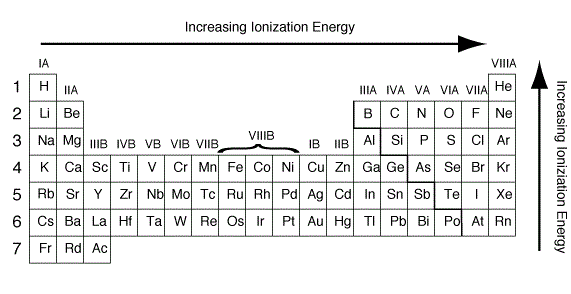
How are the trends of atomic radius and ionization energy related? Explain in both groups and periods.

These trends are inverses of each other. As the size of the atom increases, the ionization energy (energy required to remove the electron) decreases because the electron being removed is farther from the nucleus in a larger atom.Less energy is required to remove an electron further from the nucleus. [AR increases down a group while IE decreases; AR decreases across a period while IE increases.]

Atomic Radius Trends


Why are atoms larger going down a group
Atoms get larger because the higher the energy level, the more orbitals it has and the further away from the nucleus those orbitals are. Also, more electrons are interfering with the attraction that the nucleus has on the highest energy electrons [shielding].

Why do atoms get smaller going from left to right across the table.
Atoms get smaller because there is an increase in the effective nuclear charge [more protons attracting more electrons) so the highest energy level get pulled in closer to the nucleus.

Two factors that influence the changes of atomic radii in the Periodic Table

Two factors that influence the changes of atomic radii in the Periodic Table are:
  • Effective nuclear charge experienced by the valence electrons: Electrons around the nucleus experience different nucleus attraction. Those electrons closer to the nucleus experience a greater attraction than those that are farther away. The actual nuclear charge experienced by an electron is called the effective nuclear charge, Zeff. Effective nuclear charge increase, nucleus attraction stronger, atomic radii decrease. Across the period, the effective nuclear charge increases as proton number increase. As a result, the attraction between the nucleus and valence electrons become stronger, causing the atomic radius to decrease.
  • The principal quantum number, n, of the valence electrons: As going down a group, the number of shells increases, more inner electrons are present to shield the valence electrons from the nucleus. The valence electrons are farther from the nucleus. Thus, the attraction between the nucleus and valence electrons decreases, therefore, the atomic radius increase. Down a group, the atomic radius increases because of the increasing principal quantum number (n) of the valence electron.

SPM Form 4: Periodic Table of elements (Checklist)

periodic table of elements
  • Periodic Table: the table showing the elements in order of increasing proton number; similar elements are arranged in columns called groups.
  • Group: A vertical column of elements in the Periodic table.
  • Period: A horizontal row of the Periodic Table; its number tells you how many electron shells there are.
  • Alkali metals: the Group I elements of the Periodic Table, which include lithium, sodium, potassium, rubidium, caesium and francium.
  • Alkaline earth metals: the Group II elements of the Periodic Table, which include beryllium, magnesium, calcium, strontium, barium, and radium.
  • Halogens: the Group VII elements of the Periodic Table, which include fluorine, chlorine, bromine, iodine and astatine.
  • Noble gases: the Group 18 elements of the Periodic Table; they are called ‘noble’ or inert gases because they are so unreactive, which include helium, neon, argon, krypton, xenon and radon.
  • Transition elements: the elements in the wide middle block of the Periodic Table (elements in group 3 to group 12).
  • Metal: an element that shows metallic properties (for example conducts electricity, and forms positive ions)
  • Non-metal - an element that does not show metallic properties: the non-metals lie to the right of the zig-zag line in the Periodic Table.
  • Amphoteric oxide: An oxide that exhibits both acidic and basic properties.
  • The atomic radius is a term used to describe the size of the atom.
  • The ionization energy is the energy required to completely remove an electron from a gaseous atom or ion.
  • Electron affinity reflects the ability of an atom to accept an electron. It is the energy change that occurs when an electron is added to a gaseous atom.
  • Electronegativity is a measure of the attraction of an atom for the electrons in a chemical bond. The higher the electronegativity of an atom, the greater its attraction for bonding electrons.

Atomic Radius - trends on periodic table


atomic radius

Generally, the atomic radius decreases across a period from left to right and increases down a given group.

Moving from left to right across a period, electrons are added one at a time to the outer energy shell. Electrons within a shell cannot shield each other from the attraction to protons. Since the number of protons is also increasing, the effective nuclear charge increases across a period. This causes the atomic radius to decrease.

Moving down a group in the periodic table, the number of electrons and filled electron shells increases, but the number of valence electrons remains the same. The outermost electrons in a group are exposed to the same effective nuclear charge, but electrons are found farther from the nucleus as the number of filled energy shells increases. Therefore, the atomic radii increase.

Factors Affecting the Ionization Energy

ionization energy
  • Atomic radius: The valence electrons of an atom with a larger radius experience a less attraction towards nucleus, hence possesses low ionization energy.
  • Effective nuclear charge:  The higher the nuclear charge the stronger the attraction between the nucleus and electrons. This causes the ionization energy to increase.
  • Shielding effect (screening effect): The shielding effect of the electrons of the inner orbitals causes the outer electrons to be less attracted to the nucleus and thus decrease the magnitude of ionization energy.