State the general properties of ionic compounds and covalent compounds.

General properties of ionic compounds:
  • Solid at room conditions.
  • High melting point and boiling point.
  • Soluble in water but insoluble in non-polar solvents.
  • Do not conduct electricity in the solid state.
  • Conduct electricity in molten state or in aqueous solutions.

General properties of covalent compounds:
  • Low boiling point and melting point.
  • Insoluble in water but soluble in non-polar solvents.
  • Do not conduct electricity, either in the solid or molten state.

Structures and properties of metallic bonds

  • Metals can be bent (ductile) and can be stretched (malleable) because the layers of atoms in metals slide over each other when force is applied but will not break due to attractive force between electrons and metal ions.
  • Metals conduct electricity as it has free electrons which carry current.
  • Metals conduct heat as it has free electrons which gains energy when heated and moves faster to collide with metal atoms, releasing heat in collisions.
  • Metals have high melting and boiling points because the bonds between metals are very strong. Hence very high heat energy needed to break the bonds.

Ionic bonds versus Covalent bonds

  • In ionic bonds, electron pairs are shared between atoms. In covalent bonds, atoms are electrostatically attracted towards each other.
  • Ionic bonds occur through the interaction between cations and anions. Covalent bonds occur through the interaction of neutral atoms.
  • Ionic bonds are the strongest type of chemical bond.  Covalent bonds are quite weak.
  • Metallic elements tend to form ionic bonds. Non-metallic elements tend to form covalent bonds. 

Ionic compounds

An ionic compound is a compound formed by ions bonding together through electrostatic forces. Ionic compounds form when positive and negative ions share electrons and form an ionic bond. The strong attraction between positive and negative ions often produces crystalline solids that have high melting points. Ionic bonds form instead of covalent bonds when there is a large difference in electronegativity between the ions.

An ionic bond is formed when one atom accepts or donates one or more of its valence electrons to another atom. 
Example: ionic bond between the sodium and chloride ions in table salt, NaCl.

  • Ionic compounds have high melting and boiling points.
  • Ionic compounds are mostly soluble in water but insoluble in organic solvents.
  • Ionic compounds can conduct electricity in molten state but cannot conduct electricity in solid state. 

Covalent compounds

A covalent compound is a molecule formed by covalent bonds, in which the atoms share one or more pairs of valence electrons. A covalent bond is a chemical link between two atoms in which electrons are shared between them. 


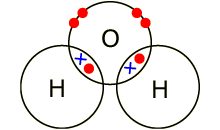
Example: covalent bond between the oxygen and hydrogen in a water molecule (H2O). Each of the covalent bonds contains two electrons - one from a hydrogen atom and one from the oxygen atom. Both atoms share the electrons.

  • Covalent compounds have low melting and boiling points.
  • Covalent compounds are mostly insoluble in water but soluble in organic solvents.
  • Covalent compounds cannot conduct electricity in solid and molten state. 

SPM Form 4: Chemical Bonds (Checklist)

  • An ionic bond is a chemical link between two atoms caused by the electrostatic force between oppositely-charged ions in an ionic compound. Examples: an ionic bond between the sodium and chloride ions in table salt, NaCl.
  • A covalent bond is a chemical link between two atoms in which electrons are shared between them. Examples: a covalent bond between the oxygen and hydrogen in a water molecule (H2O).
covalent bonds
  • Ionic compounds: a compound that consists of positive ions and negative ions arranged in the crystal lattice and are attracted to each other by strong electrostatic forces. Ionic compounds such as magnesium oxide, MgO, sodium chloride, NaCl and iron(III) chloride, FeCl3 can be respectively prepared through a reaction between a metal and a non-metal.
  • Covalent compounds are those in which the elements share electrons via covalent bonds.
  • Ionic compounds have high melting and boiling point whereas covalent compounds have low melting and boiling points.
  • Ionic compounds are mostly soluble in water but insoluble in organic solvents. Covalent compounds are mostly insoluble in water but soluble in organic solvents.
  • Ionic compounds can conduct electricity in molten state but cannot conduct electricity in solid state. Covalent compounds cannot conduct electricity in solid and molten states.
  • Melting points: the temperature at which a solid turns into a liquid at a fixed pressure.
  • Boiling point: the temperature at which the vapor pressure of a liquid equals the external pressure surrounding the liquid.
  • Solubility: the maximum quantity of a substance that may be dissolved in another or the maximum amount of solute that may be dissolved in a solvent.

SPM Chemistry Syllabus Form 4

Chapter 1: Introduction to Chemistry
1.1 Chemistry and its importance
1:2 Scientific methods

Chapter 2: The Structure of the Atom
2.1 Matter
2.2 The atomic structure
2.3 Isotopes
2.4 The electronic structure of an atom

Chapter 3: Chemical Formulae and Equations
3.1 Relative atomic mass and relative molecular mass
3.2 The mole and the number of particles
3.3 The mole and the mass of substances
3.4 The mole and the volume of gas
3.5 Chemical Formulae
3.6 Chemical Equations

Chapter 4: Periodic Table of Elements
4.1 The Periodic Table of Elements
4.2 Group 18 elements
4.3 Group 1 elements
4.4 Group 17 elements
4.5 Elements in a period
4.6 Transition elements

Chapter 5: Chemical Bonds
5.1 Formation of compounds
5.2 Ionic bonds
5.3 Covalent bonds
5.4 The properties of ionic and covalent compounds

Chapter 6: Electrochemistry
6.1 Electrolytes and non-electrolytes
6.2 Electrolysis of molten compounds
6.3 Electrolysis of aqueous solutions
6.4 Electrolysis in industries
6.5 Voltaic cells
6.6 The electrochemical series

Chapter 7: Acids and bases
7.1 Acids and bases
7.2 The strength of acids and alkalis
7.3 Concentrations of acids and alkalis
7.4 Neutralization

Chapter 8: Salts
8.1 Salts
8.2 Qualitative analysis of salts

Chapter 9: Manufactured Substances in Industry
9.1 Sulphuric acid
9.2 Ammonia and its salts
9.3 Alloys
9.4 Synthetic polymers
9.5 Glass and polymers
9.6 Composite materials